
Stan Lee's Cadillac
Plus: A Dollar For Belonging, And The Two Languages Every Comic Is Written In

Cash, Cadillacs, and Closed Doors
On April 14, 2017, I sat down for a one-on-one interview with Stan Lee on the stage of the Paley Center, raising money for the HERO Initiative.
It remains one of the highlights of my entire Marvel life.
We were up there for at least two hours. Probably more. And for legal reasons I have since forgotten, almost none of it can be seen today.
But one clip escaped.
Maybe someday the rest will too, because Stan said things that night I’d never heard him say before.
And I’d heard Stan say plenty.
But the interview isn’t the story today.
The homework is.
Weeks before the show, I got on the phone and started calling Stan’s old friends and associates, digging for stories from the heyday. I figured I’d collect a few good memories, maybe find something Stan hadn’t told a thousand times before.
What came back was better than anything I could have planned.

Flo Steinberg told me about the sounds.
Flo handled the mail in the early Marvel office, and in those days, the mail was full of money.
The Merry Marvel Marching Society had just launched. For one dollar, any kid in America could become an official member, complete with an actual membership card and a record of the actual Marvel Bullpen goofing around on it.
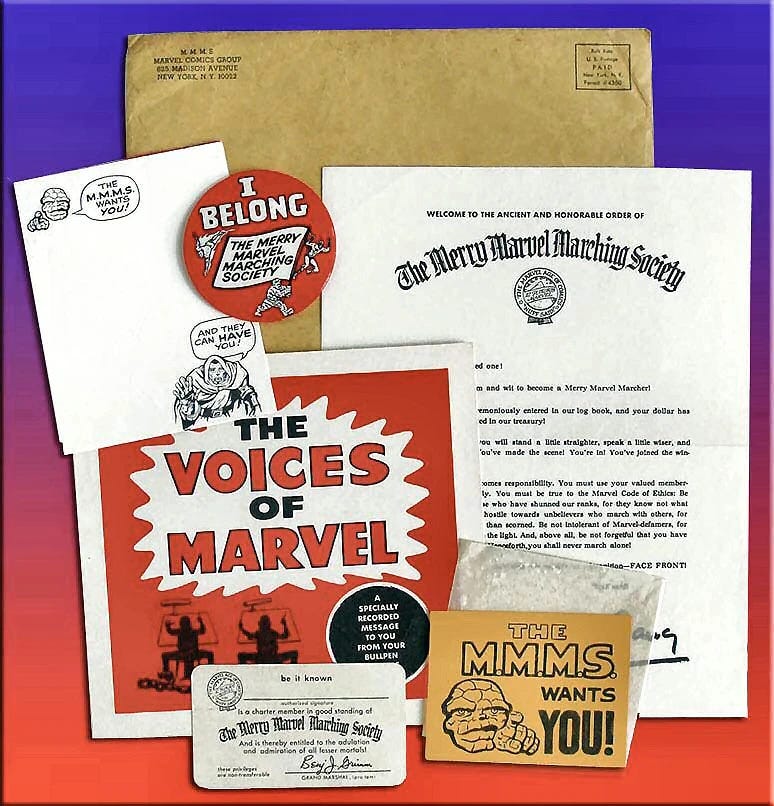
A dollar.
For belonging.
Today, a dollar gets a kid about one-sixth of a Happy Meal and no record.
So the envelopes rolled in, each with a dollar bill folded inside.
Most of them, anyway.
Some kids didn’t have a dollar bill.
But they had a dollar.
Those were the heavy envelopes. The ones that rattled.
And Flo would sit there counting out some kid’s allowance in nickels and dimes until that youngster had officially bought his way into the Marvel Universe.
Anyone who ever knew Flo knows she was far too sweet and bubbly to call that what it was. So I’ll say it for her.
What a huge pain in the ass.
And while Flo stacked bills and counted nickels, another sound was coming from behind Stan’s closed office door.
Yelling. Furniture scraping across the floor. Grown men jumping up and down like children.
That was the sound of Stan and a bunch of artists making the next batch of legendary Marvel comics.
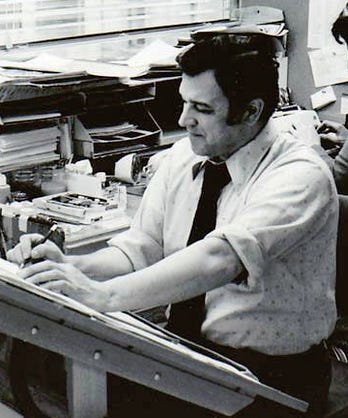
John Romita Sr. told me about the commute.
John lived on Long Island. So did Jack Kirby. So did Stan, for twenty-eight years, in Hewlett Harbor. On Fridays, Stan would sometimes drive the guys home in his big Cadillac convertible.
Picture that for a second.
Stan Lee behind the wheel of a Cadillac convertible. Jack Kirby riding shotgun, almost certainly smoking a stogie. John Romita in the back.
That alone sounds like the greatest YouTube podcast ever.
But there was one ride John never forgot.
He’s sitting in the back seat, catching maybe half the conversation over the wind and hum of the road, while up front Stan and Jack are building the next issue of Fantastic Four in real time.
And these were not two men calmly exchanging ideas.
Demonstrative doesn’t begin to cover it.
One idea on top of another. Stan throwing something out. Jack topping it. Stan topping Jack. Back and forth, bigger and crazier, until they landed on something they both liked.
Nothing was written down.
Think about that.
An issue of one of the most influential comic books of the twentieth century, composed at fifty miles an hour on the Long Island Expressway, with the only witness stuck in the back seat catching every other word.
Then Monday morning arrives.
Jack walks into the office with the entire issue penciled.
Stan gets busy writing dialogue inspired by Jack’s storytelling.
Now hold that image.
Because today’s lesson lives inside one question.
Who decides how the story gets told?
ACT VI — DISAPPEARANCE
The Invisible Language of Visual Storytelling
Part 23: The Two Languages
Every comic you have ever loved was written twice.
Once in words, once in pictures.
Making comics has always been a negotiation over who does which half, and when.
The Accidental Language
In the early 1960s, Stan had a problem most writers would kill for.
Too many books, not enough Stan.
The solution was born out of pure necessity. Stan would give his artist the plot. Sometimes it was a typed synopsis. Sometimes it was a conversation over a desk.
Sometimes it was the front seat of a Cadillac doing fifty.
Then the artist went away and wrote the comic.
Not the words.
The comic.
The pacing, panel count, staging, acting, camera, what got a whole page and what got squeezed into a sliver. Everything we’ve spent twenty-two lessons on.
The artist decided all of it at the drawing board.
The pages came back, and Stan wrote dialogue over finished storytelling. Jack Kirby famously penciled notes in the margins telling Stan what was happening in each panel, and sometimes what somebody ought to be saying inside of it.
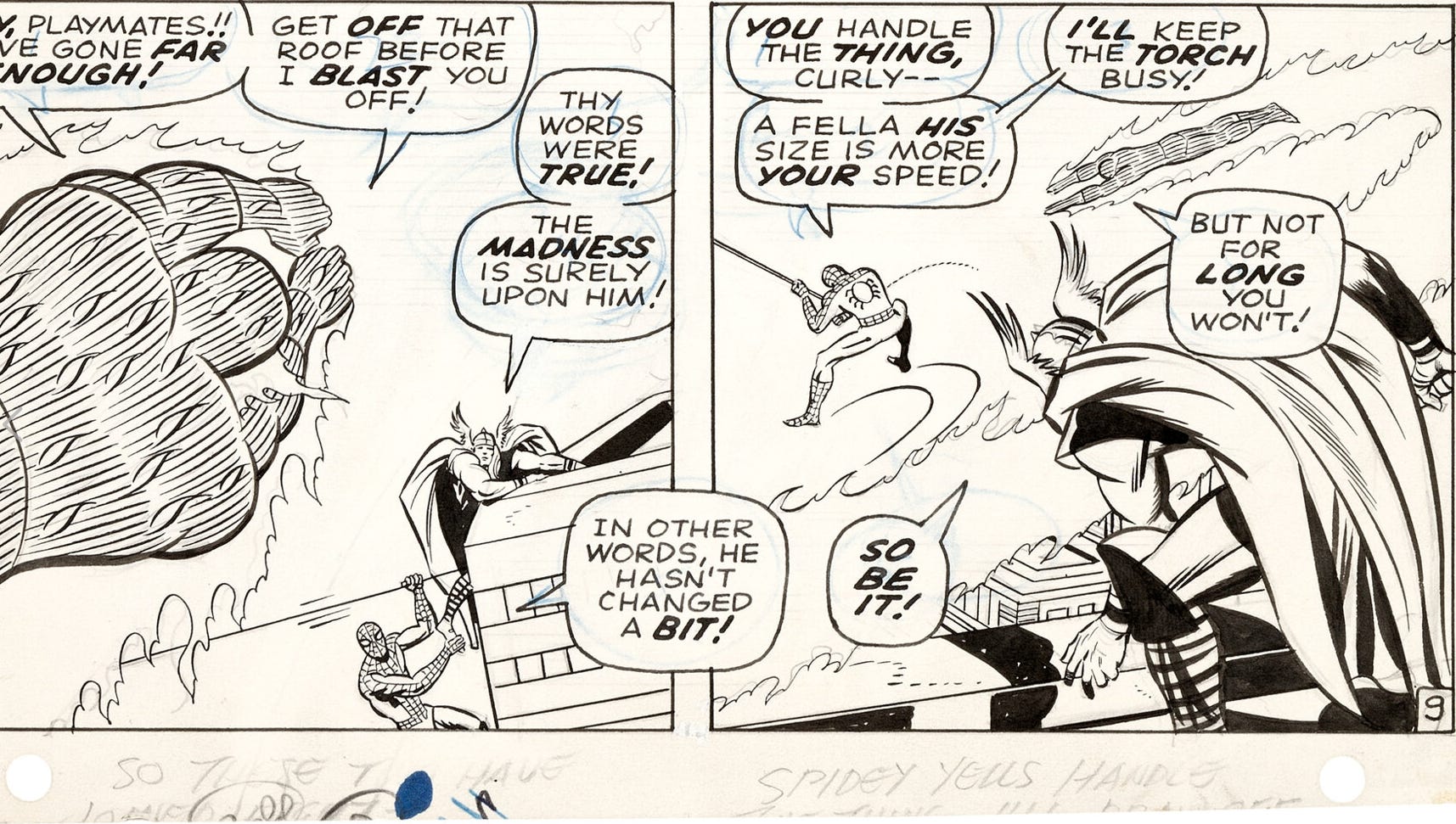
They called it the Marvel Method, which makes it sound like a plan.
It wasn’t a plan.
It was triage that turned out to be genius.
Here’s what the method gives you: an artist who’s telling the story, not illustrating it.
The person controlling your eye controls the page.
When it works, the energy is unmistakable. The pages move like they were composed, not assembled.
And here’s what it costs.
The Marvel Method puts most of the visual storytelling in the artist’s hands, which means those hands better know what they’re doing.
Pacing, staging, camera, rhythm, reveals. Every tool we’ve spent twenty-two lessons on, plus the judgment to know when to break the rules and when to leave them alone.
Hand that same plot to an artist who hasn’t earned that command, and the whole thing collapses.
There’s no script to catch anyone.
The Language of Total Control
Full script is the other contract.
Every panel described. Every caption placed. Every line of dialogue written before the artist sharpens a pencil.
The story exists complete, on paper, before a single image does.
Alan Moore, who you watched perform surgery on Swamp Thing last week, writes full scripts so dense that a single panel description can run longer than some writers’ entire plots.
Ask any artist who’s ever worked from one.
The script arrives like a phone book that dreams.
This is the first page of Moore’s Watchmen script.
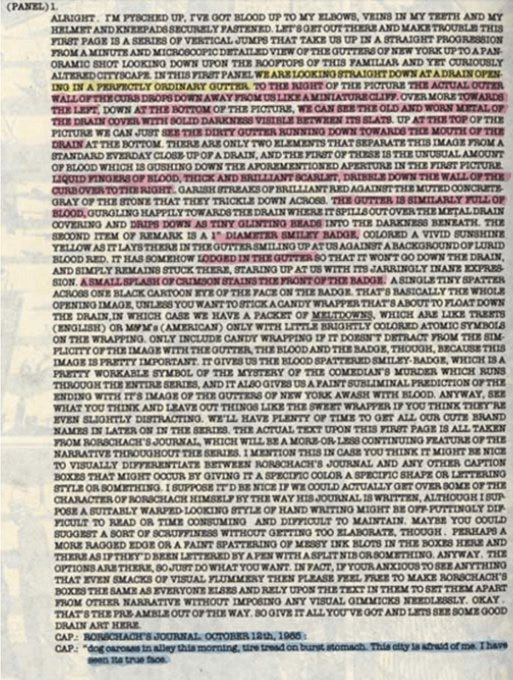
This is just his description of panel one.
Here’s what full script gives you: voice, precision, and control of time.
The page turn lands exactly where the writer engineered it, which you know from Lesson 18 is the whole ballgame.
The balloons are planned before the art exists, which you know from Lesson 21 is blocking.
In full script, the invisible machinery we’ve been studying all year is designed on the page before anyone draws a line.
And here’s what it costs.
A full script can leave the artist room to direct, or it can leave them nothing to do but obey.
The danger comes when a writer who doesn’t really think in pictures starts dictating pictures anyway.
The exception is that rare breed of writer who truly does think visually, and they’re rarer than they believe.
A full script written without a visual sense handcuffs the one person in the partnership trained to control the reader’s eye.
The artist stops being a director and becomes a courtroom sketch artist.
Neither language is better.
Marvel Method is a jam session. Somebody calls the key, counts it in, and the band finds the song together.
Full script is a symphony score. Every note is on paper before the first chair sits down.
Both make music.
And neither survives an amateur in the wrong chair.
If that sounds like the running theme of this entire curriculum, congratulations.
You’ve been paying attention.
Bilingual
One more thing before we go any further, because it matters more than almost anything else in this lesson.
This curriculum leans visual. Most of what we’ve covered lives on the art side of the desk.
But if you’re a writer and you’ve been treating these lessons as a spectator sport, you’ve been reading them wrong.
Here’s how fluency pays off.
You’re an artist, and a full script lands on your board. Because you speak the language, you can spot the places where the script isn’t hitting the notes where they should be hit.
In a great collaboration, you can always call your writer and make a suggestion.
But now you can explain why.
Not, “This feels off.”
Why.
And in most great partnerships, that conversation makes the book better for both of you.
Now flip it.
You’re a writer, the layouts come back, and a page isn’t reaching its full story potential.
Fluency lets you do the same thing in reverse.
Not just say it isn’t working.
Explain where.
And why.
If that pattern sounds familiar, you met it back in Lesson 4.
Robert McKee’s rule: even if you’re an actor with zero interest in writing, study screenwriting anyway, so you understand what the writer is doing before those words ever hit your lips.
Even if you’re a writer with zero interest in acting, take an acting class, so you know what it feels like to make your words live in front of an audience.
McKee wasn’t trying to turn actors into writers or writers into actors.
He wanted each of them to understand what the other poor bastard had to do.
Swap in writer and artist, and you have this entire lesson.
It’s all starting to come together, ain’t it?
That’s what I’m really asking of you with this whole curriculum.
Both of you speaking the same language.
Both of you able to say why.
Dialects
A few weeks ago I told you about a coffee-stained manila envelope that cost me $400.
Inside it was Frank Miller’s teleplay for Daredevil: The Man Without Fear.
Not a comic script.
A television script, with a few page layouts penciled into the margins showing where Frank saw the scenes turning.
For a while I thought of that document as a third language.
It wasn’t.
What Miller handed John Romita Jr. was the Marvel Method about as close to full script as you can get without it actually being full script.
And John took it and told the story better than anyone on the planet could.
That envelope is the whole secret of this lesson.
The two languages are real, but every partnership that lasts invents its own dialect.
When Kevin Smith couldn’t get me a full script for Daredevil #1, he gave me four or five paragraphs. I turned them into twenty-two penciled pages, and Kevin wrote the dialogue over my storytelling.
There are as many dialects as there are partnerships.
Here’s the uncomfortable truth underneath everything above:
Knowing both languages fluently has never once saved a bad partnership.
Next Week
The marriage.
What the writer leaves out on purpose. What the artist leaves in. Why the best collaborations read like one voice, and why the bad ones can sound like two people arguing from separate rooms.
And we finally open the file on Stan and Steve Ditko, two men who built Spider-Man while disagreeing about practically everything.
Thanks for reading.
You’re AMAZING!
JQ
Absolutely loved this. I'm a sucker for Marvel Bullpen lore :)))
The news about the move to Burbank feels kinda weird, but in with the new I suppose.
One time when I was a kid, at Comicfest 93 in Philly, waiting in line for a sketch from JRJR, I talked to a nice old man about Spider-Man for 20 minutes, when we were done he walked behind the booth. Turned out it was Jazzy Johnny himself!
When writing stuff I'm not drawing I almost never give artists finished dialogue.
It's a waste of time to polish something that really should be interacting with the finished art.
I LOVE Alan Moore, but don't think I could survive one of his scripts.
I just did a three page sequence this week completely informed by the lessons here.
All about the rhythm of the panels per page, their size, the spread layout, and the page turn reveal. Tales of Illuminatus! #3 coming next month!
"Thus speaks God to Eli, because you are just like him:
"²⁷ And there came a man of God unto Eli, and said unto him, Thus saith the Lord, Did I plainly appear unto the house of thy father, when they were in Egypt in Pharaoh's house?
²⁸ And did I choose him out of all the tribes of Israel to be my priest, to offer upon mine altar, to burn incense, to wear an ephod before me? and did I give unto the house of thy father all the offerings made by fire of the children of Israel?
²⁹ Wherefore kick ye at my sacrifice and at my offering, which I have commanded in my habitation; and honorest thy sons above me, to make yourselves fat with the chiefest of all the offerings of Israel my people?
³⁰ Wherefore the Lord God of Israel saith, I said indeed that thy house, and the house of thy father, should walk before me for ever: but now the Lord saith, Be it far from me; for them that honor me I will honor, and they that despise me shall be lightly esteemed.
³¹ Behold, the days come, that I will cut off thine arm, and the arm of thy father's house, that there shall not be an old man in thine house.
³² And thou shalt see an enemy in my habitation, in all the wealth which God shall give Israel: and there shall not be an old man in thine house for ever.
³³ And the man of thine, whom I shall not cut off from mine altar, shall be to consume thine eyes, and to grieve thine heart: and all the increase of thine house shall die in the flower of their age.
³⁴ And this shall be a sign unto thee, that shall come upon thy two sons, on Hophni and Phinehas; in one day they shall die both of them.
³⁵ And I will raise me up a faithful priest, that shall do according to that which is in my heart and in my mind: and I will build him a sure house; and he shall walk before my anointed for ever.
³⁶ And it shall come to pass, that every one that is left in thine house shall come and crouch to him for a piece of silver and a morsel of bread, and shall say, Put me, I pray thee, into one of the priests' offices, that I may eat a piece of bread."
( 1 Samuel 2:29)